All comments are appreciated. We read every email, but can't always respond.
Aggregate Market Value Index
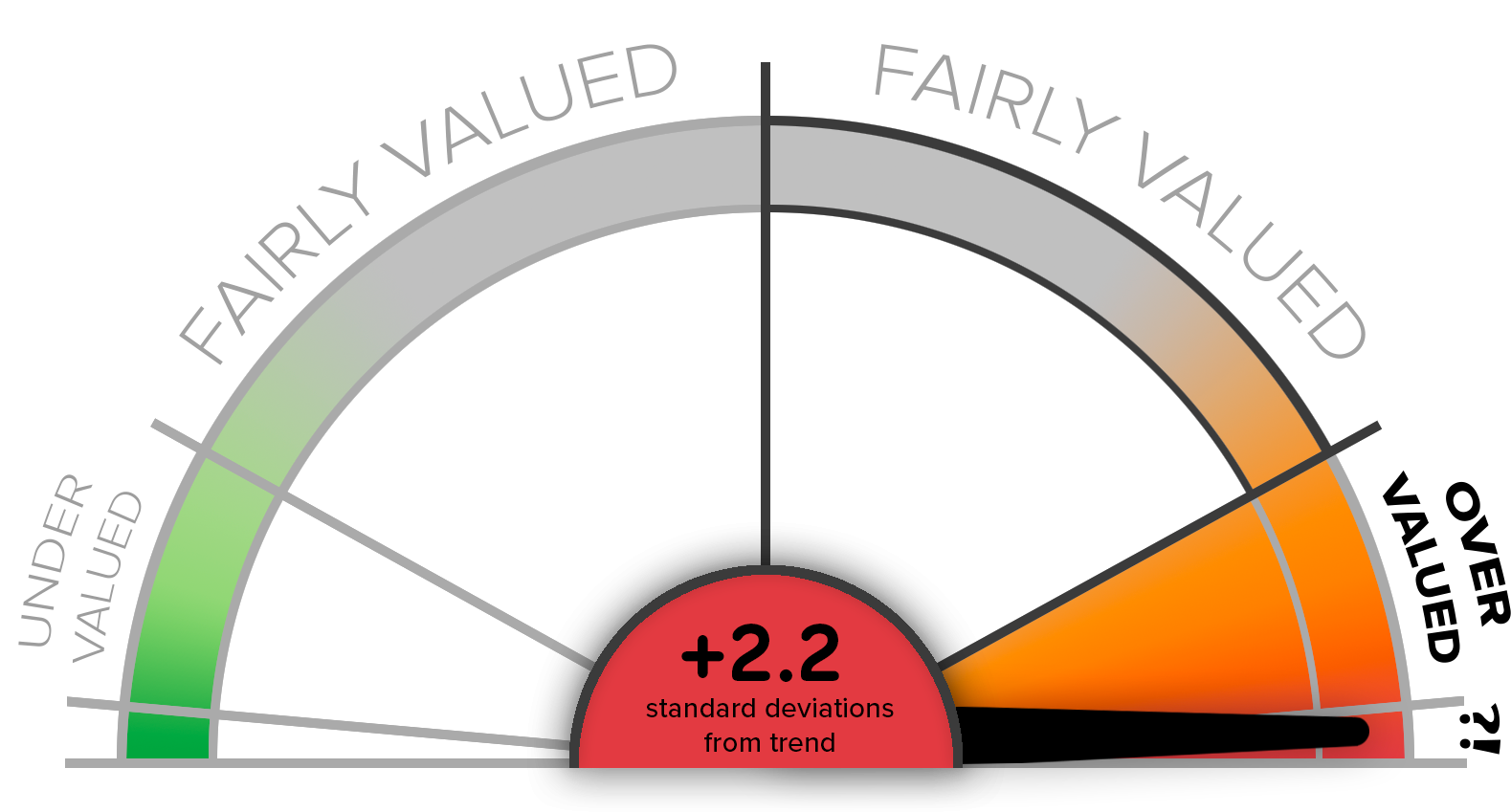
Updated October 9, 2026. The Aggregate Market Value Index model (AMVI) is a composite index of several of our market valuation models, providing a high-level view of current US stock market prices relative to historical valuation trends. This provides an idea of how overbought or oversold the market may be. The model is updated at least weekly.
While the intention is to present a view of overall market valuation, and therefore a signal as to market upside or downside, this is not a short term trading model. Markets can stay extremely under or over valued for long periods of time. Trying to time the market, even using long term business cycles such as this, has historically underperformed a buy-and-hold investment strategy.
Performance Return Horizons
Reading Correlation Charts
- The top right chart shows the valuation model score in terms of # of standard deviations above/below trend values. In most cases, values should fall between +1 and -1 about ~66% of the time. The higher the score, the more overvalued the model claims the market to be.
- The bottom right chart is the S&P500. This chart shows a purple marker for future performance, allowing you to easily visualize the relationship between the above model score and future S&P500 returns.
- The top left scatterplot chart shows every single model score plotted against the future market return, with a black line showing the linear regression. If there is no correlation between the the model and future performance, this chart should look fairly random. If the data is clumped into a diagonal line, it suggests some correlation.
- The linear regression R-Squared values are disclosed. This value represents the strength of the correlation, and ranges from 0 (no correlation) to 1 (perfectly correlated).
- High historical correlation does not imply predictive value of the model. No model can accurately predict future stock market returns.
AMVI Model Correlation w/S&P 1-Month Returns
- Scatterplot shows no clear pattern.
- On a scale of 0 to 1.00, the R-squared regression value is 0.01.
- Conclusion: There is absolutely no correlation at all between AMVI model score and subsequent 1-month S&P500 returns. This model has zero information about stock market returns 1 month out.
AMVI Model Correlation w/S&P 3-Month Returns
- Scatterplot shows no clear pattern.
- On a scale of 0 to 1.00, the R-squared regression value is 0.02.
- Conclusion: There is absolutely no correlation at all between AMVI model score and subsequent 3-month S&P500 returns. This model has zero information about stock market returns 3 months out.
AMVI Model Correlation w/S&P 1-Year Returns
- The scatterplot shows a very slight diagonal band of points, suggesting a trend is developing.
- There remain many data points in all four quadrants of the scatterplot.
- On a scale of 0 to 1.00, the R-squared regression value is 0.08.
- Conclusion: There is very little correlation between the AMVI model score and subsequent 1-year S&P500 returns.
AMVI Model Correlation w/S&P 3-Year Returns
- A slight trend is visible in the scatterplot.
- There are very few points in the lower left quadrant, showing it is quite rare for the model value to be below historic trend (less than 0), and for subsequent 3-year returns to be negative. Whereas negative returns are very frequent when model score is > 0.
- On a scale of 0 to 1.00, the R-squared regression value is 0.22. This is still quite small.
- Conclusion: There is some correlation between the AMVI model score and subsequent 3-year S&P500 returns.
AMVI Model Correlation w/S&P 5-Year Returns
- A clear trend is visible in the scatterplot.
- Almost all negative returns (left half of scatterplot) are from periods where model was at least slightly overvalued (model scores > 0).
- Even so, important to note that periods of lowest and highest 5-year returns came after relatively neutral model scores.
- On a scale of 0 to 1.00, the R-squared regression value is 0.37.
- Conclusion: There is moderate correlation between the AMVI model score and subsequent 5-year S&P500 returns.
AMVI Model Correlation w/S&P 10-Year Returns
- A clear trend is visible in the scatterplot.
- Every single instance of negative 10-year returns (left side of scatterplot) occurred when AMVI model was well above zero, and in almost every case > 1, showing Overvalued or Strongly Overvalued model scores.
- Likewise, every single instance of model undervaluation (> 1 standard dev below trend) was followed by very strong subsequent 10-year returns.
- Note, however, that the strongest instances of 10-year returns (rightmost points on scatterplot) came after model was only very slightly undervalued.
- On a scale of 0 to 1.00, the R-squared regression value is 0.58.
- Conclusion: There is moderately strong correlation between the AMVI model score and subsequent 10-year S&P500 returns.
Model Summaries
A quick visual update on each of our tracked models is below. The colored gauge represents a normal distribution curve - E.g., a model should be within +/- 1 standard deviation of its historical trend (considered to be Fairly Valued), about 66% of the time, reflected as the central gray area. Our Ratings Guide has more information.
| Model | Updated | Rating | Score | Next Update | |
|---|---|---|---|---|---|
| Valuation Models | |||||
| Buffett Indicator | Oct 9 | Strongly Overvalued | 2.47 |
|
Oct 17 |
| Price/Earnings (CAPE) | Oct 9 | Strongly Overvalued | 2.24 |
|
Oct 17 |
| Price/Sales | Oct 9 | Overvalued | 1.60 |
|
Oct 17 |
| Interest Rate Model | Oct 9 | Strongly Overvalued | 2.31 |
|
Oct 17 |
| S&P500 Mean Reversion | Oct 9 | Strongly Overvalued | 2.51 |
|
Oct 17 |
| Earnings Yield Gap | Oct 9 | Fairly Valued | 0.46 |
|
Oct 17 |
| Recession Models | |||||
| Yield Curve | Oct 9 | High | 1.99 |
|
Oct 17 |
| Sahm Rule | Sep 30 | Low | N/A |
|
Oct 03 |
| State Coincidence | Aug 31 | Normal | -0.42 |
|
Oct 24 |
| Sentiment Models | |||||
| Margin Debt | Aug 31 | Optimistic | 1.16 |
|
Oct 17 |
| Junk Bond Spreads | Oct 9 | Neutral | 0.81 |
|
Oct 17 |
| VIX Index | Oct 9 | Neutral | -0.51 |
|
Oct 17 |
| Economic Uncertainty Index | Oct 9 | Neutral | 0.89 |
|
Oct 17 |
| Consumer Confidence | Oct 9 | Very Pessimistic | -3.00 |
|
Oct 17 |
Buffett Indicator – Details
Chart shows Buffett Indicator ratio as # of standard deviations above/below its historic average.
The Buffett Indicator is the ratio of the total value of the US stock market versus the most current measure of total GDP. When this value is very high it suggests the stock market is overpriced relative to actual economic productivity. For more detail, charts, and sources, visit the Buffett Indicator Model page.
Chart shows the US Buffett Indicator value alongside its exponential trend line, dotted.
The Buffett Indicator is the ratio of the total value of the US stock market versus the most current measure of total GDP. When this value is very high it suggests the stock market is overpriced relative to actual economic productivity. For more detail, charts, and sources, visit the Buffett Indicator Model page.
| Current US Stock Market Value | $80.36 (T) |
|---|---|
| Current Forecasted GDP | $32.95 (T) |
| Current Buffett Indicator (BI) Ratio | 243.9% |
| Historical Trend BI Ratio | 136.7% |
| Current Position Relative to Trend (%) | 79% above trend |
| Current Position Relative to Trend (SDs) | 2.47 standard devs above trend |
| Rating | Strongly Overvalued |
Performance Return Horizons
Buffett Indicator Model Correlation w/S&P 1-Month Returns
- Scatterplot shows no clear pattern.
- On a scale of 0 to 1.00, the R-squared regression value is 0.00.
- Conclusion: There is absolutely no correlation at all between Buffett Indicator model score and subsequent 1-month S&P500 returns. This model has zero information about stock market returns 1 month out.
Buffett Indicator Model Correlation w/S&P 3-Month Returns
- Scatterplot shows no clear pattern.
- On a scale of 0 to 1.00, the R-squared regression value is 0.01.
- Conclusion: There is absolutely no correlation at all between Buffett Indicator model score and subsequent 3-month S&P500 returns. This model has zero information about stock market returns 3 months out.
Buffett Indicator Model Correlation w/S&P 1-Year Returns
- The scatterplot shows a very slight diagonal band of points, suggesting a trend might be developing.
- There remain many data points in all four quadrants of the scatterplot.
- On a scale of 0 to 1.00, the R-squared regression value is 0.05. This is still extremely low.
- Conclusion: There is very little correlation between the Buffett Indicator model score and subsequent 1-year S&P500 returns.
Buffett Indicator Model Correlation w/S&P 3-Year Returns
- A slight trend is visible in the scatterplot.
- There are very few points in the lower left quadrant, showing it is quite rare for the model value to be below historic trend (less than 0, meaning model suggests the market is Undervalued), and for subsequent 3-year returns to be negative. Whereas negative returns are very frequent when model score is > 0 (top left quadrant).
- On a scale of 0 to 1.00, the R-squared regression value is 0.17. This is still very small.
- Conclusion: There is some slight correlation between the Buffett Indicator model score and subsequent 3-year S&P500 returns.
Buffett Indicator Model Correlation w/S&P 5-Year Returns
- A clear trend is now visible in the scatterplot.
- Almost all negative returns (left half of scatterplot) are from periods where the model was at least slightly Overvalued (model scores > 0).
- On a scale of 0 to 1.00, the R-squared regression value is 0.28.
- Conclusion: There is some correlation between the Buffett Indicator model score and subsequent 5-year S&P500 returns.
Buffett Indicator Model Correlation w/S&P 10-Year Returns
- A very clear trend is visible in the scatterplot.
- Every single instance of negative 10-year returns (left side of scatterplot) occurred when Buffett Indicator model was well above zero, and in almost every case > 1, showing Overvalued or Strongly Overvalued model scores.
- Likewise, every single instance of model undervaluation (> 1 standard dev below trend) was followed by very strong subsequent 10-year returns.
- On a scale of 0 to 1.00, the R-squared regression value is 0.62. This is quite high for a model of this kind.
- Conclusion: There is moderately strong correlation between the Buffett Indicator model score and subsequent 10-year S&P500 returns.
Price Earnings (CAPE) – Details
Chart shows current CAPE value as # of standard deviations above/below historic average.
The PE Ratio Model tracks the ratio of the total price of the US stock market versus the total average earnings of the market over the prior 10 years (aka the Cyclically Adjusted PE or CAPE). For more detail, charts, and sources, visit the PE Model page.
Chart shows CAPE ratio value over time.
The PE Ratio Model tracks the ratio of the total price of the US stock market versus the total average earnings of the market over the prior 10 years (aka the Cyclically Adjusted PE or CAPE). For more detail, charts, and sources, visit the PE Model page.
| Current SP500 Price | $7,812 |
|---|---|
| Current S&P500 Yearly Earnings | $352/sh |
| Current S&P500 P/E Ratio | 22.2 |
| Current S&P500 10-Year Earnings Ave | $0/sh |
| Current S&P500 CAPE Ratio | 39.8 |
| Historic Average CAPE Ratio | 20.8 |
| Current Position Relative to Average (%) | 90.8% above average |
| Current Position Relative to Average (SDs) | 2.2 standard devs above trend |
| Rating | Strongly Overvalued |
Performance Return Horizons
CAPE Model Correlation w/S&P 1-Month Returns
- Scatterplot shows no clear pattern.
- On a scale of 0 to 1.00, the R-squared regression value is 0.00.
- Conclusion: There is absolutely no correlation at all between CAPE model score and subsequent 1-month S&P500 returns.
CAPE Model Correlation w/S&P 3-Month Returns
- Scatterplot shows no clear pattern.
- On a scale of 0 to 1.00, the R-squared regression value is 0.01.
- Conclusion: There is absolutely no correlation at all between the CAPE model score and subsequent 3-month S&P500 returns.
CAPE Model Correlation w/S&P 1-Year Returns
- Scatterplot shows no clear pattern.
- On a scale of 0 to 1.00, the R-squared regression value is 0.03. This is still extremely low.
- Conclusion: There is no meaningful correlation between the CAPE model score and subsequent 1-year S&P500 returns.
CAPE Model Correlation w/S&P 3-Year Returns
- A slight trend is visible in the scatterplot.
- On a scale of 0 to 1.00, the R-squared regression value is 0.07. This is incredibly small.
- Conclusion: There is no meaningful correlation between the CAPE model score and subsequent 3-year S&P500 returns.
CAPE Model Correlation w/S&P 5-Year Returns
- A clear trend is now visible in the scatterplot.
- The most highly overvalued periods of the model (scores > 2) correlate well with negative future returns, but little other trend is visible, and many of the markets best 5-year returns were after periods of overvaluation.
- On a scale of 0 to 1.00, the R-squared regression value is 0.13. This is still quite low.
- Conclusion: There is some correlation between the CAPE model score and subsequent 5-year S&P500 returns.
CAPE Model Correlation w/S&P 10-Year Returns
- A very clear trend is visible in the scatterplot.
- The most overvalued model scores (> 2) all correlate with poor subsequent 10-year market returns..
- The strongest performing 10-year periods of the S&P500 followed after CAPE model showed pretty nuetral valuation.
- On a scale of 0 to 1.00, the R-squared regression value is 0.34.
- Conclusion: There is some correlation between the CAPE model score and subsequent 10-year S&P500 returns.
Price to Sales – Details
Chart shows current price to sales ratio value as # of standard deviations above/below historic average.
The Price to Sales Ratio Model tracks the ratio of the total price of the US stock market versus the total amount of sales (revenue) generated by the stock market in the prior 12 months. For more detail, charts, and sources, visit the Price to Sales Model page.
| Current SP500 Price | $7,812 |
|---|---|
| S&P500 Trailing 12-Mo Sales | $2,844/sh |
| Current S&P500 P/S Ratio | 2.8 |
| Average S&P500 P/S Ratio | 1.9 |
| Current P/S Ratio Relative to Average (SDs) | 1.6 standard devs above average |
| Rating | Overvalued |
Performance Return Horizons
Price to Sales Model Correlation w/S&P 1-Month Returns
- Scatterplot shows no clear pattern.
- On a scale of 0 to 1.00, the R-squared regression value is 0.00.
- Conclusion: There is absolutely no correlation at all between the price to sales ratio and subsequent 1-month S&P500 returns.
Price to Sales Model Correlation w/S&P 3-Month Returns
- Scatterplot shows no clear pattern.
- On a scale of 0 to 1.00, the R-squared regression value is 0.00.
- Conclusion: There is absolutely no correlation at all between the price to sales ratio and subsequent 3-month S&P500 returns.
Price to Sales Model Correlation w/S&P 1-Year Returns
- Scatterplot shows no clear pattern.
- On a scale of 0 to 1.00, the R-squared regression value is 0.00. This is still extremely low.
- Conclusion: There is absolutely no correlation at all between the price to sales ratio and subsequent 1-year S&P500 returns.
Price to Sales Model Correlation w/S&P 3-Year Returns
- Scatterplot shows no clear pattern.
- On a scale of 0 to 1.00, the R-squared regression value is 0.00. This is incredibly small.
- Conclusion: There is absolutely no correlation at all between the price to sales ratio and subsequent 3-year S&P500 returns.
Price to Sales Model Correlation w/S&P 5-Year Returns
- Scatterplot shows no clear pattern.
- On a scale of 0 to 1.00, the R-squared regression value is 0.00. This is still quite low.
- Conclusion: There is absolutely no correlation at all between the price to sales ratio and subsequent 5-year S&P500 returns.
Price to Sales Model Correlation w/S&P 10-Year Returns
- A trend is visible in the scatterplot - periods with the highest overall return occur in the 10 years after the lowest points in the model.
- Note that the data set is quite limited. The model only begins in 2000, so there are only ~15 years of 10-year return data. In particular, there are few data points available for 10-year returns after the model was high or above average.
- On a scale of 0 to 1.00, the R-squared regression value is 0.21.
- Conclusion: There is some correlation between the CAPE model score and subsequent 10-year S&P500 returns.
Interest Rate Model – Details
Chart shows Interest Rate Valuation Model as # of standard deviations above/below historic model average.
Low interest rates should generally drive higher equity prices. This model examines the relative S&P500 position given the relative level of interest rates. For more detail, charts, and sources, visit the Interest Rate Model page.
| Current 10Year Tsy Bond Rate | 5.22% |
|---|---|
| Ave 10Y Tsy Bond Rate (Since 1962) | 5.80% |
| Current 10Y Bond Rate Relative to Average (SDs) | 0.20 standard devs below average |
| Current S&P500 Price | $7,812 |
| S&P500 Exponential Trend Value | $4,074 |
| Current S&P500 Price Relative to Trend (SDs) | 2.5 standard devs above trend |
| Composite SP500 Price relative to Current Interest Rates | 2.31 standard devs above trend |
| Rating | Strongly Overvalued |
Performance Return Horizons
Interest Rate Model Correlation w/S&P 1-Month Returns
- Scatterplot shows no pattern.
- On a scale of 0 to 1.00, the R-squared regression value is 0.01.
- Conclusion: There is absolutely no correlation between the Interest Rate model score and subsequent 1-month S&P500 returns.
Interest Rate Model Correlation w/S&P 3-Month Returns
- Scatterplot shows no clear pattern.
- On a scale of 0 to 1.00, the R-squared regression value is 0.02.
- Conclusion: There is no correlation between the Interest Rate model score and subsequent 3-month S&P500 returns.
Interest Rate Model Correlation w/S&P 1-Year Returns
- The scatterplot shows a very slight diagonal band of points, suggesting a trend might be developing.
- There remain many data points in all four quadrants of the scatterplot.
- On a scale of 0 to 1.00, the R-squared regression value is 0.06. This is still extremely low.
- Conclusion: There is very little correlation between the Interest Rate model score and subsequent 1-year S&P500 returns.
Interest Rate Model Correlation w/S&P 3-Year Returns
- A slight trend is visible in the scatterplot, though it doesn't quite resemble a diagonal line.
- Many of the strongest 3-year market returns came after Fairly Valued and Overvalued model scores (top right of scatterplot).
- On a scale of 0 to 1.00, the R-squared regression value is 0.14. This is still very small.
- Conclusion: There is some slight correlation between the Interest Rate model score and subsequent 3-year S&P500 returns.
Interest Rate Model Correlation w/S&P 5-Year Returns
- A trend is somewhat visible in the scatterplot, though a large portion of datapoints in the top-right quadrant still show instances where an Overvalued model score was followed by very high subsequent model returns.
- On a scale of 0 to 1.00, the R-squared regression value is 0.20. This is still pretty low.
- Conclusion: There is some slight correlation between the Interest Rate model score and subsequent 5-year S&P500 returns.
Interest Rate Model Correlation w/S&P 10-Year Returns
- A very clear diagonal trend is visible in the scatterplot, though it remains accompanied by a large number of datapoints in the top-right quadrant showing instances where an Overvalued model score was followed by very high subsequent model returns.
- Every single instance of negative 10-year returns (left side of scatterplot) occurred when the model was well above zero, and in almost every case > 1, showing Overvalued or Strongly Overvalued model scores.
- On a scale of 0 to 1.00, the R-squared regression value is 0.27. This is still not high.
- Conclusion: Historically there has been some (low) correlation between the Interest Rate model score and subsequent 10-year S&P500 returns.
S&P500 Mean Reversion – Details
Chart shows S&P500 as # of standard deviations above/below its historic trendline value.
A straightforward model stipulating that eventually the S&P500 will tend to return towards its historic trend line. For more detail, charts, and sources, visit the Mean Reversion Model page.
Chart shows nominal (non-inflation adjusted) S&P500 price data, with the long term exponential regression trend line.
A straightforward model stipulating that eventually the S&P500 will tend to return towards its historic trend line. For more detail, charts, and sources, visit the Mean Reversion Model page.
| Current S&P500 Price | $7,812 |
|---|---|
| S&P500 Exponential Trend Value | $4,074 |
| Current S&P500 Price Relative to Trend (%) | 92% above trend |
| Current S&P500 Price Relative to Trend (SDs) | 2.5 standard devs above trend |
| Rating | Strongly Overvalued |
Performance Return Horizons
S&P500 Mean Reversion Model Correlation w/S&P 1-Month Returns
- Scatterplot shows no clear pattern.
- On a scale of 0 to 1.00, the R-squared regression value is 0.01.
- Conclusion: There is no correlation between the S&P500 Mean Reversion model score and subsequent 1-month S&P500 returns.
S&P500 Mean Reversion Model Correlation w/S&P 3-Month Returns
- Scatterplot shows no clear pattern.
- On a scale of 0 to 1.00, the R-squared regression value is 0.02.
- Conclusion: There is no correlation between the S&P500 Mean Reversion model score and subsequent 3-month S&P500 returns.
S&P500 Mean Reversion Model Correlation w/S&P 1-Year Returns
- The scatterplot shows a slight diagonal trend developing.
- There remain many data points in all four quadrants of the scatterplot.
- On a scale of 0 to 1.00, the R-squared regression value is 0.08. This is still extremely low.
- Conclusion: There is very little correlation between the S&P500 Mean Regression model score and subsequent 1-year S&P500 returns.
S&P500 Mean Reversion Model Correlation w/S&P 3-Year Returns
- A clear trend is visible in the scatterplot.
- There are very few points in the lower left quadrant, showing it is quite rare for the model value to be below historic trend (less than 0, meaning model suggests the market is Undervalued), and for subsequent 3-year returns to be negative. Whereas negative returns are very frequent when model score is > 0 (top left quadrant).
- On a scale of 0 to 1.00, the R-squared regression value is 0.22.
- Conclusion: There is slight correlation between the S&P500 Mean Reversion model score and subsequent 3-year S&P500 returns.
S&P500 Mean Reversion Model Correlation w/S&P 5-Year Returns
- A clear trend is visible in the scatterplot.
- All negative returns (left half of scatterplot) are from periods where the model was at least slightly Overvalued (model scores > 0).
- On a scale of 0 to 1.00, the R-squared regression value is 0.35.
- Conclusion: There is some correlation between the S&P500 Mean Reversion model score and subsequent 5-year S&P500 returns.
S&P500 Mean Reversion Model Correlation w/S&P 10-Year Returns
- A very clear trend is visible in the scatterplot.
- Every single instance of negative 10-year returns (left side of scatterplot) occurred when the model score was > 1, showing Overvalued or Strongly Overvalued market valuation.
- Likewise, every single instance of relative model undervaluation (> 0 standard dev below trend) was followed by positive subsequent 10-year returns.
- On a scale of 0 to 1.00, the R-squared regression value is 0.68. This is very high for a model of this kind.
- Conclusion: There is strong correlation between the S&P500 Mean Reversion model score and subsequent 10-year S&P500 returns.
Earnings Yield Gap – Details
Chart shows spread between the S&P500 earnings yield and 10-year US Treasury yield. Note the inverted Y-axis. Negative spreads (top of chart) indicate opportunities where stocks are overvalued relative to bonds.
This model just compares the earnings yield of S&P500 vs Treasuries as an indicator of the relative value between the two. For more detail, charts, and sources, visit the Earnings Yield Gap page.
| Current S&P500 Price | 7,812 |
|---|---|
| Current S&P500 Earnings | 351.70 |
| Current S&P500 Earnings Yield | 4.50 |
| Current 10-Year Treasury Yield | 5.22 |
| Earnings Yield Gap | -0.72 |
| Earnings Yield Gap - Long Term Average | 0.25 |
| Current Yield Gap Relative to Average (SDs) | 0.5 standard devs below average Note: Below average → overvalued. Above average → undervalued |
| Rating | Fairly Valued |
Performance Return Horizons
Earnings Yield Gap Model Correlation w/S&P 1-Month Returns
- Scatterplot shows no clear pattern.
- On a scale of 0 to 1.00, the R-squared regression value is 0.00.
- Conclusion: There is no correlation between the Earnings Yield Gap model score and subsequent 1-month S&P500 returns.
Earnings Yield Gap Model Correlation w/S&P 3-Month Returns
- Scatterplot shows no clear pattern.
- On a scale of 0 to 1.00, the R-squared regression value is 0.01.
- Conclusion: There is no correlation between the Earnings Yield Gap model score and subsequent 3-month S&P500 returns.
Earnings Yield Gap Model Correlation w/S&P 1-Year Returns
- Scatterplot shows no clear pattern.
- On a scale of 0 to 1.00, the R-squared regression value is 0.01. This is essentially zero.
- Conclusion: There is no correlation between the Earnings Yield Gap model score and subsequent 1-year S&P500 returns.
Earnings Yield Gap Model Correlation w/S&P 3-Year Returns
- Scatterplot is not evenly distributed, but there is no clear trend. Highly positive and negative S&P500 returns occur regardless of Yield Gap model score.
- On a scale of 0 to 1.00, the R-squared regression value is 0.00.
- Conclusion: There is no correlation between the Earnings Yield Gap model score and subsequent 3-year S&P500 returns.
Earnings Yield Gap Model Correlation w/S&P 5-Year Returns
- Scatterplot is not evenly distributed, but there is no clear trend.
- On a scale of 0 to 1.00, the R-squared regression value is 0.00.
- Conclusion: There is no correlation between the Earnings Yield Gap model score and subsequent 5-year S&P500 returns.
Earnings Yield Gap Model Correlation w/S&P 10-Year Returns
- There is no clear trend visible in the scatterplot. If anything, scatterplot suggests that extreme model values (both overvalued and undervalued) correlate with the highest subsequent 10-year S&P500 returns.
- On a scale of 0 to 1.00, the R-squared regression value is 0.01.
- Conclusion: There is zero correlation between the Earnings Yield Gap model score and subsequent 10-year S&P500 returns, nor at any other time horizon. While this model is theoretically useful in determining if stocks are overvalued relative to bonds, the model has historically provided zero information relative to future S&P500 performance.
Yield Curve – Details
Chart shows spread between 10-year and 3-month Treasury debt. Standard deviations above/below the historical average spread are shown in vertical bands. Inversions (where 10-year yields are lower than 3-month yields) are highlighted in red.
Yield curve inversions highlighted red. When short term (3-month) Treasury yields are higher than long term (10-year) yields, it is a bearish signal that is almost always followed by economic recession. For more detail, charts, and sources, visit the Yield Curve Model page.
Chart shows the current yield curve (as well as prior two month end curves).
Typical curve should slope upwards as long-duration investments demand higher returns. A downward sloping curve suggests investors think long term interest rates will be falling sharply in the future. Downward sloping yield curves have very reliably preceded economic recessions. For more detail, charts, and sources, visit the Yield Curve Model page.
| Current 3-Month Treasury Yield | 4.23% |
|---|---|
| Current 10-Year Treasury Yield | 5.22% |
| Current 10Y-3Mo Spread | 0.99% |
| Average 10Y-3Mo Spread | 1.31% |
| Current Position Relative to Average (SDs) | 1.99 standard devs above average |
| Rating | Risk of upcoming recession is: High |
Sahm Rule – Details
Chart shows the Sahm Rule value, a measure of the current 3-month moving average of unemployment compared to the prior 12-month low of that same stat. When this value is above 0.50% it is a historically accurate signal that the economy has entered a recession. Likewise, if this value is negative (indicating that unemployment is lower than at any point in prior year), the economy has never been in recession.
For more detail, charts, and sources, visit the Sahm Rule Model page.
Chart shows the 3-month average unemployment rate, as well as the prior 12-month minimum. When the gap between these two (aka, the Sahm Rule Value) is > 0.50%, the economy is usually in a recession.
For more detail, charts, and sources, visit the Sahm Rule Model page.
| Current Unemployment Rate | 4.2% |
|---|---|
| 3-Month Average Unemployment Rate | 4.13% |
| Lowest 3-Month Ave Unemployment Rate in the last year | 4.1% |
| Sahm Rule Value | 0.00% |
| Rating | Risk of current recession is: Low |
State Coincidence – Details
Chart shows # of US states with shrinking month-over-month coincidence indicator scores. National recessions are shaded.
State Coincidence Index (SCI) is an aggregate measure of individual state economic health. This model charts the number of states with month-over-month declines in their SCI values, as compiled by the Philadelphia Fed. On average, if more than 25 states are in decline, the US overall has entered a recession.
Chart data is from the Philadelphia Federal Reserve and only available monthly. For more detail, charts, and sources, visit the State Coincidence Indicator Model page.
| Current number of states with declining SCI: | 3 |
|---|---|
| Average number of states with declining SCI: | 7.68 |
| Rating | Risk of current recession is: Normal |
Margin Debt – Details
Chart shows year-over-year changes in total margin debt levels, as % of total market value. Standard deviation bands are also shown.
Margin debt is money investors borrow to invest in stocks. High margin debt indicates bullish investors who borrow money to invest in stocks, and tends to lead stock market corrections, particularly after margin rates begin falling from their peak. This model looks at year-over-year changes in margin as a percent of total stock market value. For more detail, charts, and sources, visit the Margin Debt Model page.
Chart shows margin debt levels as % of total market value.
Margin debt is money investors borrow to invest in stocks. High margin debt indicates bullish investors who borrow money to invest in stocks, and tends to lead stock market corrections, particularly after margin rates begin falling from their peak. This model looks at year-over-year changes in margin as a percent of total stock market value. For more detail, charts, and sources, visit the Margin Debt Model page.
| Current Margin Debt Amount | $1,454(B) |
|---|---|
| Year-over-year (YoY) Change in Margin Debt | $358(B) |
| YoY Change in Margin Debt as % of Total Stock Market Value | 0.45% |
| Above value in terms of standard deviations | 1.16 standard devs above trend |
| Rating | Market sentiment is Optimistic |
Junk Bond Spreads – Details
Chart shows historical spread between junk bonds and equal maturity Treasury bonds.
High junk bond spreads (low values on chart) indicate pessimistic sentiment as investors require very high compensation for taking on the additional credit risk of low quality bonds. Low junk bond spreads indicate optimistic investors eager to take on risk, even for relatively low return, compared to safer treasury investments. For more detail, charts, and sources, visit the Junk Bond Spreads Model page.
Chart shows historical spread between junk bonds and 10-Year Treasury bonds.
High junk bond spreads indicate pessimistic sentiment as investors require very high compensation for taking on the additional credit risk of low quality bonds. Low junk bond spreads indicate optimistic investors eager to take on risk, even for relatively low return, compared to safer treasury investments. For more detail, charts, and sources, visit the Junk Bond Spreads Model page.
| Current Spread of Junk Bonds over US Treasury Bonds | 3.15 |
|---|---|
| Average spread | 5.17 |
| Current position versus average (SDs) | 0.8 standard devs below trend |
| Rating | Market sentiment is Neutral |
VIX Fear Index – Details
Chart shows VIX value since inception.
The VIX index is a mathematical measure of expected volatility in the S&P500 over the next 30 days. For example, a VIX of 20 indicates that the market expects the S&P500 to go either up or down over the next 30 days at a 20% annualized rate (or about 1/12th of 20% over the next 30 days). While the VIX does not make a claim if the market is over or under valued, in practice very high values of the VIX tend to precede market crashes. For more detail, charts, and sources, visit the VIX Fear Index Model page.
Chart shows recent S&P500 values and the VIX-implied volatility expected over the next 30 days.
The VIX index is a mathematical measure of expected volatility in the S&P500 over the next 30 days. For example, a VIX of 20 indicates that the market expects the S&P500 to go either up or down over the next 30 days at a 20% annualized rate (or about 1/12th of 20% over the next 30 days). While the VIX does not make a claim if the market is over or under valued, in practice very high values of the VIX tend to precede market crashes. For more detail, charts, and sources, visit the VIX Fear Index Model page.
| Current VIX Value | 15.41 |
|---|---|
| Average VIX | 19.36 |
| Current position versus average (%) | 20% below average |
| Current position versus average (SDs) | 0.5 standard devs below average |
| Rating | Market sentiment is Neutral |
Economic Policy Index – Details
Chart shows the Economic Policy Uncertainty Index score over time, as well as bands indicating its standard deviation.
This index tracks the sentiment of economic policy uncertainty in the United States. The index includes sentiment analysis from newspaper articles, and measures of forecast disparity from economic forecasters. A very high value indicates very high levels of uncertainty about future economic policy. This is a contrarian indicator. While uncertainty is generally bad for business, very high uncertainty sentiment can represent emotional overreactions. As Buffett said, "be greedy when others are fearful". For more information see the Economic Policy Uncertainty model page.
Performance Return Horizons
Economic Policy Uncertainty Model Correlation w/S&P 1-Month Returns
- Scatterplot shows no clear pattern.
- On a scale of 0 to 1.00, the R-squared regression value is 0.00.
- Conclusion: There is absolutely no correlation at all between Economic Policy Uncertainty model score and subsequent 1-month S&P500 returns. This model has zero information about stock market returns 1 month out.
Economic Policy Uncertainty Model Correlation w/S&P 3-Month Returns
- Scatterplot shows no clear pattern.
- On a scale of 0 to 1.00, the R-squared regression value is 0.02.
- Conclusion: There is absolutely no correlation at all between Economic Policy Uncertainty model score and subsequent 3-month S&P500 returns. This model has zero information about stock market returns 3 months out.
Economic Policy Uncertainty Model Correlation w/S&P 1-Year Returns
- Scatterplot shows no clear pattern.
- On a scale of 0 to 1.00, the R-squared regression value is 0.05.
- Conclusion: There is very little correlation between Economic Policy Uncertainty model score and subsequent 1-year S&P500 returns. This model has basically zero information about stock market returns 1 year out.
Economic Policy Uncertainty Model Correlation w/S&P 3-Year Returns
- Scatterplot shows no clear pattern.
- On a scale of 0 to 1.00, the R-squared regression value is 0.02.
- Conclusion: There is absolutely no correlation at all between Economic Policy Uncertainty model score and subsequent 3-year S&P500 returns. This model has zero information about stock market returns 3 years out.
Economic Policy Uncertainty Model Correlation w/S&P 5-Year Returns
- A trend is beginning to appear in the scatterplot.
- The top-left quadrant is nearly empty, showing that there were very few periods where there were high levels of economic policy uncertainty that were followed by negative 5-year returns.
- Almost all negative returns (left half of scatterplot) are from periods where the model was at least slightly Overvalued (model scores > 0).
- On a scale of 0 to 1.00, the R-squared regression value is 0.07.
- Conclusion: There is some very slight correlation between the Economic Policy Uncertainty model score and subsequent 5-year S&P500 returns.
Economic Policy Uncertainty Model Correlation w/S&P 10-Year Returns
- A light trend is visible in the scatterplot.
- The top-left quadrant is nearly empty, showing that there were very few periods where there were high levels of economic policy uncertainty that were followed by negative 10-year returns.
- The periods of most positive 10-year returns followed periods of (slight) market pessimism.
- On a scale of 0 to 1.00, the R-squared regression value is 0.10. This is not a high value at all.
- Conclusion: There is some very slight correlation between the Economic Policy Uncertainty model score and subsequent 10-year S&P500 returns.
Consumer Confidence – Details
Chart shows Consumer Sentiment value since inception.
The University of Michigan Consumer Sentiment Index (CSI) is a long-running gauge of how confident U.S. households feel about both their current financial situation and the economic outlook. It combines assessments of present buying conditions with expectations for personal finances and business conditions over the next several years, producing a single composite measure of consumer mood. Because consumer spending drives most U.S. economic activity, shifts in the CSI often provide early clues about turning points in growth, earnings, and market sentiment. High readings signal optimism and willingness to spend, while low readings typically accompany periods of economic stress or heightened uncertainty. For more detail, charts, and sources, visit the full model page.
Chart shows overall Consumer Sentiment and its component parts
The University of Michigan Consumer Sentiment Index (CSI) is a long-running gauge of how confident U.S. households feel about both their current financial situation and the economic outlook. It combines assessments of present buying conditions with expectations for personal finances and business conditions over the next several years, producing a single composite measure of consumer mood. Because consumer spending drives most U.S. economic activity, shifts in the CSI often provide early clues about turning points in growth, earnings, and market sentiment. High readings signal optimism and willingness to spend, while low readings typically accompany periods of economic stress or heightened uncertainty. For more detail, charts, and sources, visit the full model page.
| Current Consumer Sentiment Index (CSI) Value | 46.30 |
|---|---|
| Average CSI | 85.39 |
| Current position versus average (SDs) | 3.0 standard devs below average |
| Rating | Market sentiment is Very Pessimistic |
Data Downloads
Download the latest Current Market Valuation data and model files in Microsoft Excel format.
Files are updated monthly as new economic and market data becomes available, and typically released 2-3 days after month end.
Last updated: August 2026
Monthly CMV model data is available to Data Download members in Microsoft Excel format.
Select a file to upgrade your membership and access the complete download library. Learn more about Data Download membership.

Click any file to view Data Download membership options.